
Using Verbal Reactions
One of the best ways to deter puppy bites is to react consistently with verbal noise. Every time your puppy bites, say “NO!” in a firm voice. Then just walk away and ignore the puppy. Social isolation and time outs can be an effective form of punishment for a pack animal. You can also yelp when your puppy bites too hard. It might seem silly but puppies in a litter will cry out if a sibling accidentally bites too hard. Yelping when your puppy lays teeth on your will give feedback to very young puppies about what is acceptable playing and what isn’t.
Educating Children
Teach children not to shriek, run or flap their hands because this will engage the puppy’s natural prey instincts and add to the problem. Children should remain calm and keep their hands closed and close to their bodies.
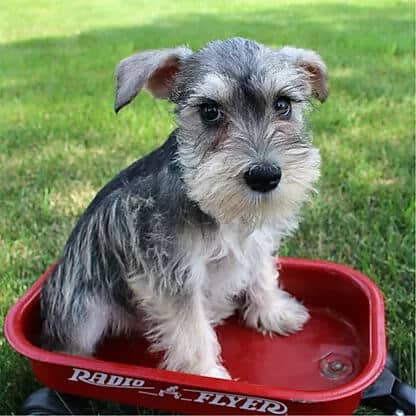
Taste Training
Use a taste deterrent to keep your puppy from biting. Before you start playing with your puppy, spray a taste deterrent on areas of your body and clothes that your puppy likes to play rough with. When your puppy starts biting you, stop moving and wait for it to react to the taste deterrent. Once your puppy stops biting, praise him/her and continue playing. Make sure you wash your hands thoroughly with soap and water to get the material off your hands.
Taste deterrents include: “Bitter Apple,” “Vick’s Vapor Rub,” or white vinegar. Use these on your hands to make them taste unpleasant. Contrary to a previous post, please note that tea tree oil can cause temporary paralysis in dogs; use products that are tested as safe for dogs/animals.
Teething Toys
Redirect your puppy’s attention using teething toys. When your Schnauzer has calmed down, gently talk to him/her. Keep your hand away from your Schnauzer’s mouth. Start playing again and avoid getting the puppy excited. This time, use toys instead of your hands to get your puppy engaged. Start playing fetch, so that you are tossing toys away from you and using the puppy’s prey drive for positive fun. Playing with toys can be used as a training reward or break and keeps your hands away from the puppy’s teeth.
Some trainers suggest playing tug-of-war with your puppy. The puppy learns that the game is fun, but is also controlled by you, the human at the other end of the toy. The fun will stop if the rules of the game aren’t honored, keeping everyone safe.
Slow Down!
Play safely while you supervise training. Never play roughly with a Schnauzer that bites. Rough play will only encourage this behavior and strongly establish it in the puppy’s mind. Never use your hands as toys. You should also closely watch children playing around or with the puppy. Kids are not equipped to train a puppy and injuries can happen.
Don’t let children play tug with the puppy unless an adult is present, the puppy fully understands the rules, and only if the puppy’s size does not pose a risk to the child during the game.
Spray Bottle
Use a water spray bottle in severe cases. In cases where biting is exceptionally strong or persistent, keep a water spray bottle handy. Accompany your firm “NO!” with a squirt of water in puppy’s face to interrupt the behavior. Take care to set the nozzle to spray and not jet. You just want to startle the puppy, not harm. Be aware that the puppy will associate the water spray with you, and this could make him wary of you at other times.
Never threaten your Schnauzer with the squirt bottle or create fear. You also don’t want to create a situation where the puppy only behaves if the squirt bottle is in your hand.
Positive Reinforcement
Reward good behavior. Always praise good behavior with lots of gentle love and cuddles. Use rewards effectively to reinforce good behavior. For example, if your dog successfully responds to your request to drop a toy, say, “yes!,” or “good boy!” Verbal rewards work well when you’re playing and may have your hands full of toys.
Remember, you are now the puppy’s parent. It’s your responsibility to encourage him to become a happy, healthy, well-adjusted family member.
Schanuzer Puppies and playing with litter-mates
1. Understand how puppies usually learn about biting. It’s normal for puppies to bite as they develop and grow. Usually, they learn about not biting from other members of their pack, including adult dogs. Puppies learn by playing with other pack mates about when to avoid causing serious damaging through biting. If puppies don’t learn to control or stop biting, the other dogs will punish the puppy more severely, possibly by biting the puppy to cause injury.
If the puppy does learn easily from his pack mates, they’ll become more forceful and clear about biting behavior until the puppy behaves in a manner acceptable to other members of its pack.
2. Realize the importance of teaching your dog not to bite. If you allow puppy biting, it may get out of control and your puppy will not learn to control his bite. This can lead to serious behavioral issues when your puppy reaches adulthood. If you suspect your puppy is biting out of fear or anger, talk with an animal behavioral therapist, who may be able to help.
It is not acceptable for puppies to bite people, or other animals, unless they are in true physical danger and need to defend themselves.